


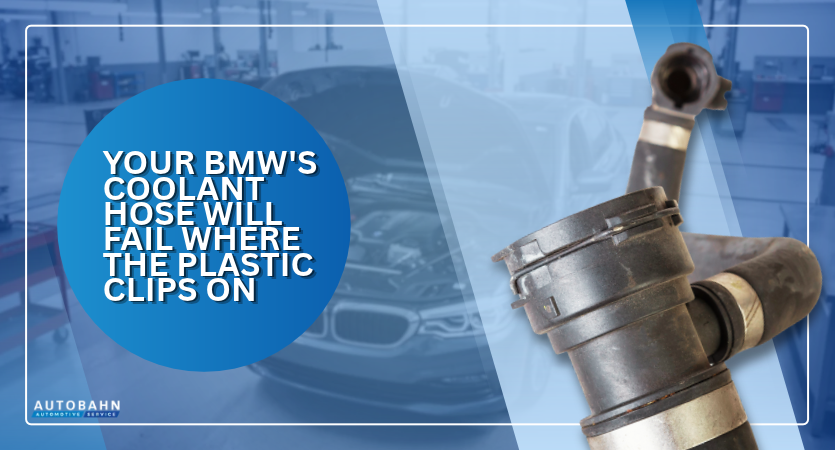
American households averaged $4,765 on vehicle expenses outside the purchase price and fuel in 2025, according to the Bureau of Labor Statistics. A fair slice of that is repair work that began as something small. On a BMW in San Antonio, few parts illustrate it better than a coolant hose — an inexpensive length of rubber with plastic ends that can take a water pump, a cylinder head or an entire engine with it.
Quick Summary: Key Takeaways
- The fitting fails first: rubber ages slowly, while the molded plastic collar that clips onto the radiator or thermostat housing goes brittle years ahead of it.
- Heat sets the clock: years of under-hood temperatures near Loop 410 cook the plasticizers out of those collars, and what is left snaps under load.
- Feel the collar with a thumbnail: a healthy one is firm and slightly flexible, and a failing one feels chalky and crazed.
Modern BMW cooling systems are plastic almost everywhere
Walk around an older European engine bay and the coolant plumbing is metal pipe and rubber hose held on with worm clamps. Walk around an N20, N55, B46 or B58 and it is a network of molded plastic: the thermostat housing, the expansion tank, the radiator end tanks, and the fittings on every hose that joins them.
BMW did that for good reasons. Plastic is lighter, it can be molded into shapes a pipe bender cannot reach, and the quick-connect design assembles in seconds on the production line. The trade is service life. Reinforced polymer tolerates heat beautifully for years and then reaches a point where it does not tolerate it at all.
Heat ages the fitting faster than mileage does
Under-hood temperatures in South Texas sit high for a long stretch of the year, and they stay high after shutdown, when there is no airflow at all and the heat soaks outward from the block. That soak is what drives the plasticizer out of the molded collars.
Mileage barely tracks with it. A garage-kept 3 Series with 60,000 miles can have fittings as brittle as a 140,000-mile X5, because both have sat through the same number of heat cycles. Age and climate are the better predictors, and ten years is where we start looking carefully.
What a failing fitting looks like before it lets go
Open the hood on a cold engine and look where each hose meets a housing. You are looking for crust — dried coolant, white or pale blue depending on what is in the system — ringing the joint. You are also looking at color and texture. A collar that has gone from deep black to a dusty gray, or that shows fine spiderweb cracks around its shoulder, is on borrowed time.
Press the collar gently with a thumbnail. Plastic that is still sound gives slightly under the pressure. Brittle plastic feels like a seashell and may even creak faintly under the pressure. The creak is the part telling you what comes next.
The low-coolant warning and a faint sweet smell after shutdown both belong on this list, though by the time either appears the leak is already established.
Cooler mornings are when brittle plastic actually breaks
Through the hottest stretch of the year the system lives at one temperature band and the plastic stays expanded. As overnight lows drop into the fifties and forties, the parts contract every night and expand again on the morning drive, and that cycling is what finishes a crazed collar.
So cooling failures cluster in cooler weather in a city where nobody expects them. The damage was done during the heat. The break happens once the weather turns, often on a cold start, in a driveway, with no warning at all.
A thirty-second failure does more damage than a slow leak
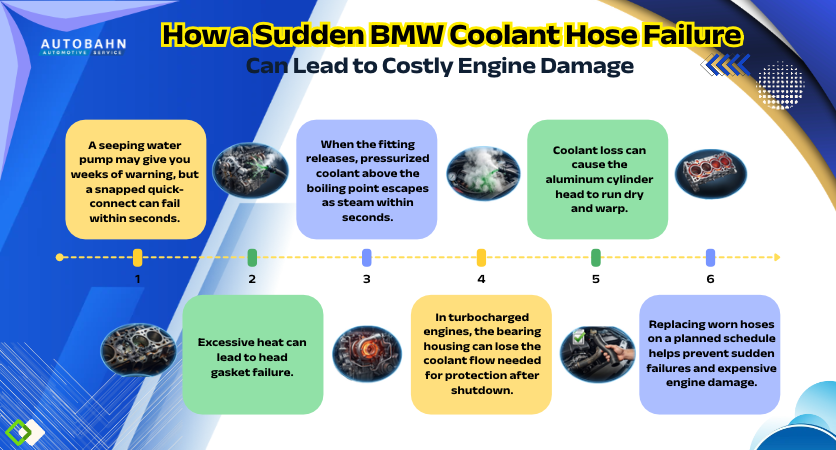
A seeping water pump gives you weeks. A snapped quick-connect gives you the length of one on-ramp. The system is pressurized and the coolant is well above the boiling point of water, so when the fitting releases, most of it leaves as steam in a few seconds.
What follows is the expensive part. An aluminum head that runs dry warps, head gaskets fail, and on a turbocharged engine the bearing housing loses the coolant flow that protects it after shutdown. A small part becomes an engine bill that way, and it is the single best argument for replacing tired hoses on a schedule you choose.
How we replace them, and what goes back on with them
We replace quick-connect hoses as assemblies, with new O-rings, and we do not reuse a retaining clip that has already been heat-cycled for a decade. Clips are inexpensive and a reused one is the most common reason a fresh hose weeps a week later.
While the system is open, the sensible move is to look at everything sharing that environment: the expansion tank and its cap, the thermostat housing, and the radiator end tanks where the plastic is crimped to the core. If two of the four are brittle, all four are the same age.
Refilling matters as much as the parts. The system is vacuum-filled so no air pocket is left behind, then run up to temperature and pressure-tested, because an air pocket will make a perfectly repaired car run hot.
Ten-Year-Old Coolant Plastic Deserves an Inspection
If your BMW is past ten years old and has never had its coolant plumbing inspected, that inspection is quick and it is the cheapest insurance in the engine bay.
Autobahn Automotive — 2306 NE Loop 410, San Antonio, TX 78217