


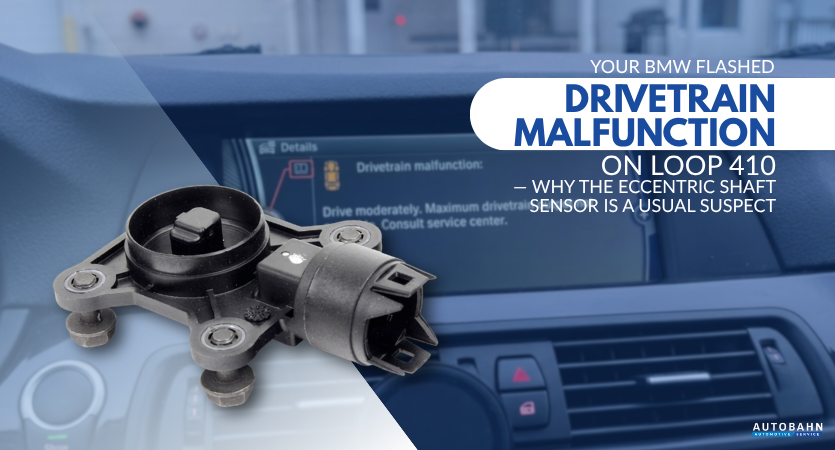
A BMW drivetrain malfunction warning means the engine computer has logged a fault it can’t trust and cut power to protect itself. Power drops. The yellow message appears, and the car won’t pull past a lazy merge onto Loop 410. On BMW engines that carry a separate Valvetronic eccentric shaft sensor, such as the N52, that sensor is one of the first parts worth checking. Have it read in San Antonio before Thanksgiving, in a bay off NE Loop 410, rather than on the shoulder of I-10 past Kerrville.
Quick Summary: Key Takeaways
- The warning caps power on purpose: the engine computer has logged a fault it can’t trust and limits output until someone reads the code.
- On an N52, the eccentric shaft sensor is a usual suspect: it reports where the Valvetronic shaft sits; the N20 and N55 build it into the motor.
- A weak battery can fake it: low voltage sets the same message, so test the battery before buying parts.
A BMW Drivetrain Malfunction Warning Is a Protective Power Cut
The warning means the DME, BMW’s engine computer, has stored a fault serious enough to limit power. You’ll usually be told to drive moderately. The car still moves. It just holds back.
That’s deliberate. Rather than risk a misfire overheating the catalytic converters or a lean mixture damaging a piston, the computer trims output and saves a code that points the scan tool at whatever tripped it. The message is generic, the code behind it isn’t, which is why swapping parts off a forum thread so rarely ends well. Restarting sometimes clears the text, but the code stays stored.
Valvetronic Uses the Eccentric Shaft as a Throttle
Valvetronic sets engine power by changing how far the intake valves open, and the eccentric shaft sensor tells the DME exactly where that setting is. An electric motor rotates the eccentric shaft, and the shaft’s angle decides how much lift each intake valve gets, which is the job a throttle plate does on most cars.
So the sensor matters. When its reading drops out, jumps around or stops matching what the motor was told to do, the DME loses faith in its own airflow math and pulls power. On the N52, the sensor reads a magnet mounted on the shaft itself. BMW’s N20 training manual says the eccentric shaft sensor is integrated in the Valvetronic servomotor on that engine and the N55, so there a position fault points at the motor.
Symptoms That Point to the Sensor, and When They Don’t
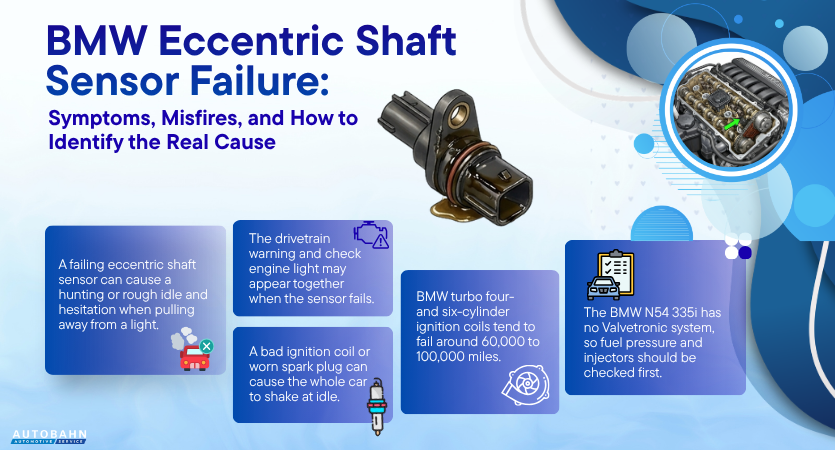
A failing eccentric shaft sensor usually shows up as a hunting or rough idle, hesitation pulling away from a light, and the drivetrain warning arriving together with the check engine light.
Misfires feel different. A bad coil or worn plug shakes the whole car at idle, and the check engine light may flash. On turbo four- and six-cylinder BMWs, coils tend to give out around 60,000 to 100,000 miles. And an N54 335i has no Valvetronic at all. On that engine, look at fuel pressure and injectors first.
Valve Cover Oil and a Tired Battery Set the Same Trap
Two everyday problems can fake this fault. The first is oil. A valve cover gasket that weeps on an N52-powered 328i or X3 can wick oil toward the sensor and its plug, and a connector sitting in oil gives a dirty signal.
The second is voltage. The Valvetronic motor is one of the heavier loads on the engine, so a battery that limped through a San Antonio summer often fails the first cold-front morning in November and sets drivetrain faults on the way down. Check it first.
Diagnosis Compares Commanded and Reported Shaft Position
A proper diagnosis compares the position the DME commanded with the position the sensor reports, then checks the sensor’s wiring and connector before any part gets ordered. Autobahn Automotive runs BMW’s ISTA platform, scans every module rather than just the engine, and hands you a written diagnostic report of what it found.
If the sensor is bad, it gets replaced, and on engines where it hides under the valve cover, a fresh valve cover gasket goes on at the same time. Then the Valvetronic end stops are relearned with the scan tool. That step matters. Skip it and the warning can return. On an N20 or N55, a position fault that survives the wiring check points at the servomotor itself.
Get It Read Before the Holiday Miles
An intermittent drivetrain fault tends to reappear under sustained load, which is exactly what a holiday run north on I-35 to Austin or out I-10 into the Hill Country delivers. AAA Texas projected that 5.3 million Texans would travel by car over Thanksgiving 2025, and it expected 29,000 roadside assistance calls in the state that holiday. It might stay quiet across town for a week, then return on the first long climb out of the city.
The shop sits on NE Loop 410 near Wetmore Road, a short drive for BMW owners in Stone Oak, Alamo Heights and Terrell Hills, so fit the scan into the week before the trip. Clearing the code doesn’t repair anything.
Frequently Asked Questions
Q: Can I keep driving my BMW with a drivetrain malfunction warning?
A: Usually, if the trips are short and gentle. The car is already limiting power. If the check engine light flashes or the engine shakes, stop and have it towed.
Q: What causes drivetrain malfunction in a BMW?
A: Common causes include a failing Valvetronic eccentric shaft sensor or motor, misfires from coils or plugs, VANOS faults, fuel pressure problems and low battery voltage. The stored code says which.
Q: How do I reset the drivetrain malfunction message on a BMW?
A: A restart can hide the message and a scan tool can erase the code, but neither touches the cause, so the warning returns.
Book a BMW Drivetrain Diagnosis in San Antonio
A stored code carries freeze-frame data from the moment the fault set, so leave it in place for the scan. Drive it gently to 2306 NE Loop 410, San Antonio, TX 78217, and mention when you book whether the warning came with a flashing check engine light. The BMW diagnostic pages at autobahnautomotive.com list what the ISTA scan covers.