



Quick Takeaways:
- San Antonio’s triple-digit heat makes a marginal AC system fail when you need it most.
- European AC failures trace to aging seals, a failing compressor, or a module fault.
- Recharging without finding the leak is temporary – the leak keeps leaking.
- Stop-and-go traffic on Loop 410 and I-10 with minimal condenser airflow is the hardest AC condition.
- Autobahn Automotive’s European AC service at 2306 NE Loop 410 uses proper leak detection and factory-level tools.
San Antonio summers do not ease in gradually. By June, the heat is settling over Loop 410 and the I-10 corridor, parking lots radiate triple-digit surface temperatures, and the difference between a car you can stand to drive and one you cannot comes down entirely to the air conditioning. European vehicles – Audi, BMW, Mercedes, Porsche, Land Rover, Volkswagen, MINI, Volvo, and Jaguar – run sophisticated climate systems that work beautifully when healthy and become miserable when a single component fails. Autobahn Automotive has been the area’s European specialist for more than 40 years, with its shop at 2306 NE Loop 410, and AC season is when San Antonio drivers find out whether their system is ready for the heat.
What are the most common European car AC failures in San Antonio?
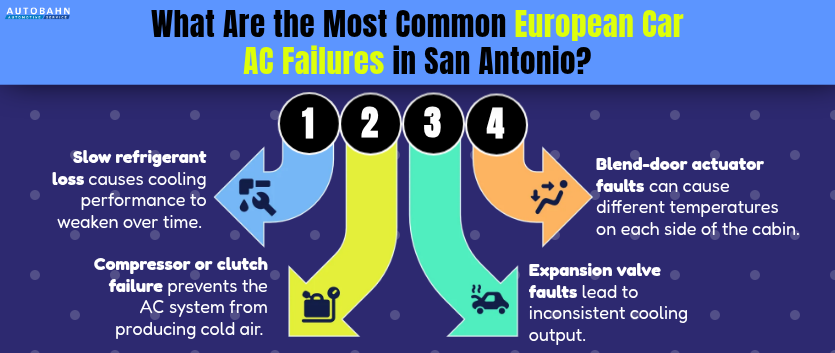
Slow refrigerant loss is the most frequently diagnosed cause of weak cooling. The system gradually sheds charge through micro-leaks at O-ring seals, the condenser, or hose fittings, and the symptom is cooling that starts adequately in spring and fades as summer demand climbs. A system running low also runs its compressor harder than designed, which shortens the compressor’s life.
Compressor and clutch failure produce a different complaint – air at ambient temperature, regardless of setting, because the refrigerant cycle never starts. Expansion valve faults cause inconsistent output, and on many German models, a blend-door actuator or module fault produces split cabin temperatures where one side cools and the other does not. Distinguishing these requires real diagnosis. Schedule European auto air conditioning service at Autobahn Automotive before a heat wave turns a marginal system into a no-cool emergency.
Why is a quick recharge the wrong fix for a San Antonio summer?
A sealed AC system does not lose refrigerant on its own. If your European car needs a recharge to cool, that refrigerant left through a leak, and that leak will keep leaking after the top-off. A quick-lube recharge in May might get you to July before the warm air returns, and during that time the compressor has been running with less lubricating oil than it needs, because refrigerant carries the compressor oil through the circuit.
That is the path from a minor seal leak to a major compressor replacement. The correct sequence is to pressure-test the system, pinpoint the leak with an electronic detector or UV dye, repair it, then evacuate and recharge to specification. Automotive refrigerant handling is regulated under the U.S. EPA’s Clean Air Act Section 609, and a proper specialist follows those procedures rather than just adding refrigerant. Autobahn’s approach is diagnose first, repair the cause, then recharge.
How does San Antonio traffic and heat shorten AC component life?
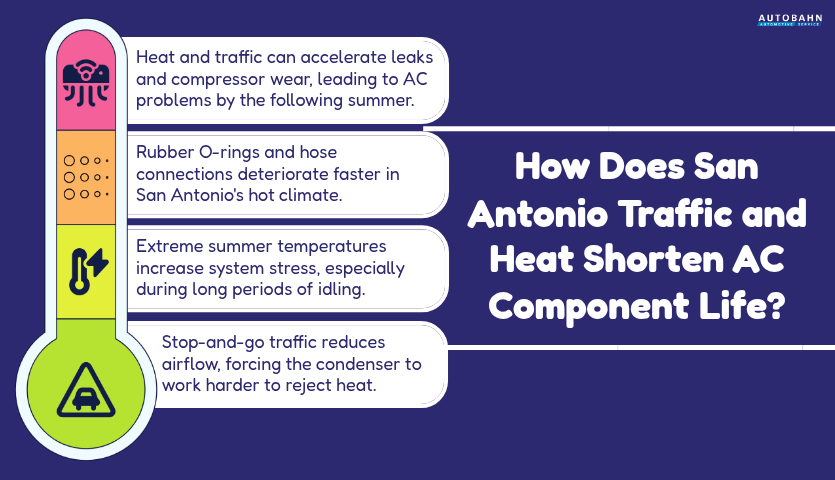
The condenser sits at the front of the vehicle, directly exposed to road heat, debris, and the relentless San Antonio sun, and it depends on airflow to reject heat. In stop-and-go traffic on Loop 410 or I-10 – where the car barely moves, and the only airflow comes from the cooling fans – the system works at its limit even when healthy. Add sustained 100-degree-plus temperatures, and the rubber O-rings and hose connections degrade faster here than in milder climates.
This is why a system perfectly fine last fall can develop a leak or weak compressor by the following summer. An early-season inspection – checking refrigerant charge, condenser, and compressor engagement before the worst heat arrives – is the practical way to avoid discovering a problem in a July traffic jam. Contact Autobahn Automotive to book a pre-summer AC inspection at 2306 NE Loop 410.
What does a proper European AC diagnosis look like at Autobahn Automotive?
It begins with a system pressure test to confirm the charge level and reveal pressure anomalies that point toward a specific fault – a restriction, an overcharge, or a failing compressor each leaves a distinct signature on the gauges. From there, electronic leak detection or UV dye locates the exact leak source rather than guessing. Many European climate systems also store fault data in the climate-control module – blend-door positions, sensor values, compressor-request signals – that requires manufacturer-appropriate equipment to read.
Generic recharge machines access none of that information; they simply add refrigerant until the gauge looks right and send the car back out. Autobahn’s technicians, working on European cars for over four decades, run the full diagnostic sequence so the repair addresses the actual cause and the cooling lasts through the whole San Antonio summer.
Frequently Asked Questions
Q: How do I know if my European car’s AC compressor is failing?
A: A failed compressor clutch produces no cooling at all – ambient air regardless of setting. A worn compressor that still engages may cool intermittently, make unusual noises, or trigger a warning. Autobahn can test compressor engagement and output during a diagnostic visit at 2306 NE Loop 410.
Q: How long does an AC repair take at Autobahn Automotive?
A: A simple O-ring or seal repair with a recharge is often same-day. Condenser or compressor replacement may take one to two days, depending on the model and parts. Autobahn provides a specific timeline after the diagnosis.
Q: Will Autobahn just recharge my AC if that is all I want?
A: Autobahn will always check for a leak first, because recharging a leaking system only postpones the problem and risks the compressor. The shop will explain what it finds and let you decide – but a recharge alone on a leaking system is not a lasting fix.
Q: Which European brands does Autobahn Automotive service?
A: Autobahn specializes in Audi, BMW, Jaguar, Land Rover, Mercedes-Benz, MINI, Porsche, Volkswagen, and Volvo, and services most other makes as well. Call (210) 657-1180 to confirm service for your vehicle.
Contact
Autobahn Automotive
2306 NE Loop 410, San Antonio, TX 78217
Phone: (210) 657-1180
Website: autobahnautomotive.com
Hours: Mon-Thu 7:30 AM – 5:30 PM, Fri 7:30 AM – 3:30 PM