


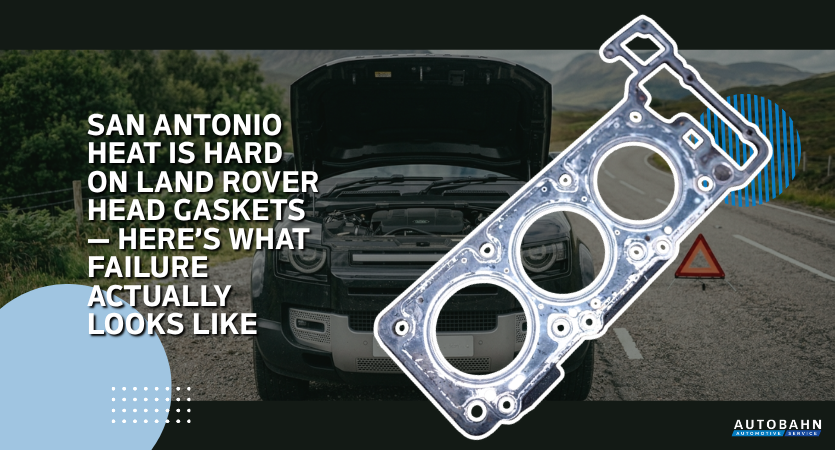
Land Rover builds vehicles that handle extreme conditions — rocky terrain, river crossings, mountain passes. What they haven’t always handled as gracefully is relentless urban heat, and San Antonio‘s summers have a way of finding the weakest point in any cooling system. For Land Rover owners driving on Loop 410 or I-35, head gasket failure is one of the more expensive problems the brand is known for, and it almost always starts with signs that are easy to explain away. By the time the failure becomes undeniable, the repair cost has usually grown considerably. Autobahn Automotive on NE Loop 410 has been the San Antonio area’s trusted European specialist for over 40 years, and their technicians know Land Rover head gasket failure from the first subtle warning to the final diagnosis.
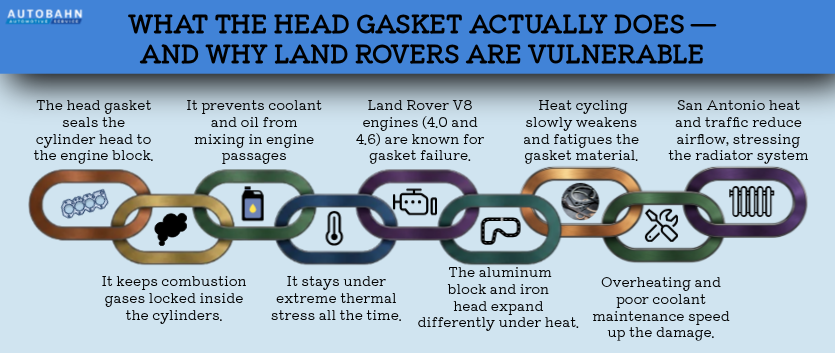
What the Head Gasket Actually Does — and Why Land Rovers Are Vulnerable
The head gasket seals the cylinder head to the engine block, keeping combustion gases in the cylinders and coolant and oil in their respective passages. It’s under enormous thermal stress at all times. Land Rover’s V8 engines — particularly the 4.0 and 4.6 — developed a reputation for head gasket failure years ago, and the root cause is largely the same across generations: the aluminum block and iron head expand at different rates under heat cycling, which gradually fatigues the gasket material. Repeated temperature extremes, any history of overheating, or deferred coolant maintenance all accelerate this process. San Antonio’s summer temperatures, combined with stop-and-go traffic that limits airflow to the radiator, create exactly the conditions that push head gaskets toward failure faster than in milder climates. Learn more about Land Rover repair at Autobahn Automotive and the full scope of services available for your vehicle.
Early Warning Signs You Shouldn’t Ignore
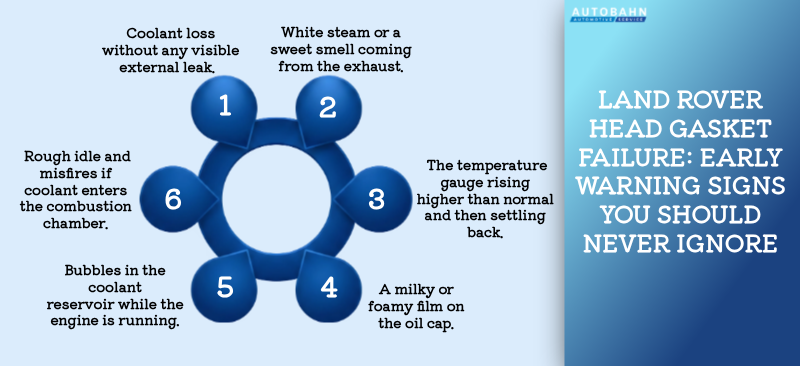
Head gasket failure rarely happens without warning — the problem is that the early signs are easy to minimize. The first thing most Land Rover owners notice is coolant loss without a visible external leak: you add coolant periodically, it keeps disappearing, and you assume there’s a slow drip somewhere. Meanwhile, white steam or a sweet smell from the exhaust is intermittent and seems to come and go. The temperature gauge climbs a bit higher than usual on a hot afternoon and settles back down. None of these individually seem like a crisis. Together, they are a clear picture of a head gasket beginning to fail. Other signs include a milky or foamy film on the oil cap, bubbles in the coolant reservoir when the engine is running, or rough idle and misfires if coolant is entering the combustion chamber. Catching any of these early allows for a controlled repair rather than a breakdown on the side of I-10.
What Happens If You Wait
Driving a Land Rover with a compromised head gasket accelerates the damage in two directions. On the coolant side, continued loss leads to overheating, and overheating warps the cylinder head — which turns a head gasket replacement into a head gasket replacement plus cylinder head resurfacing or replacement. On the oil side, coolant contamination destroys bearing surfaces and accelerates wear throughout the engine. A repair that costs one amount when caught early can triple in cost once secondary damage is factored in. Autobahn Automotive’s scheduled maintenance program is designed to catch exactly these kinds of developing problems before they reach the expensive stage — consistent coolant service and pressure testing are the front line of defense.
How Autobahn Automotive Diagnoses and Repairs Land Rover Head Gaskets
Diagnosis starts with a cooling system pressure test, a combustion gas test of the coolant, and a thorough inspection of fluid condition. In many cases, a block test — which detects combustion gases in the coolant — confirms a failing head gasket before the engine shows dramatic symptoms. Once confirmed, the repair involves removing the cylinder head, inspecting it for warping or cracking, replacing the gasket with a quality OEM-spec part, and pressure-testing the cooling system after reassembly. Autobahn Automotive uses factory-grade diagnostic equipment and backs all repairs with a 12-month/12,000-mile warranty. Bosch financing is available if the repair timing is inconvenient.
FAQ
What are the signs of a failing Land Rover head gasket?
Common symptoms include unexplained coolant loss, white exhaust smoke, a sweet smell from the exhaust, milky residue on the oil filler cap, a rising temperature gauge, and rough idle or misfires. Any of these should be investigated promptly at a Land Rover specialist.
Can a Land Rover head gasket be repaired, or does the engine need to be replaced?
In most cases, a head gasket replacement is the appropriate repair — especially when caught before secondary damage occurs. If the cylinder head is warped or cracked, it may need to be resurfaced or replaced alongside the gasket. Engine replacement is typically only necessary if the failure was allowed to cause significant internal damage.
Why are Land Rover head gaskets prone to failure?
The aluminum block and iron cylinder head in many Land Rover V8 engines expand at different rates under heat cycling, which fatigues the gasket over time. Overheating events, deferred coolant maintenance, and extreme ambient temperatures all accelerate the process.
How much does Land Rover head gasket repair cost in San Antonio?
Cost varies depending on the specific engine, whether the cylinder head requires machining, and the extent of any secondary damage. Autobahn Automotive provides upfront estimates, and Bosch financing is available. Call or schedule online for a diagnosis.
San Antonio’s Land Rover Head Gasket Specialist
Autobahn Automotive has been serving European vehicle owners across San Antonio for over 40 years, with dealer-level equipment and experienced technicians who know Land Rover inside and out.
📍 2306 NE Loop 410, San Antonio, TX 78217 📞 (210) 657-1180 🕐 Mon–Thu: 7:30 AM–5:30 PM | Fri: 7:30 AM–3:30 PM 🌐 autobahnautomotive.com